100+ Signups in 3 Days: My Zero-Budget SaaS Launch Strategy
In 2022, I worked on launching Bullet.so, a SaaS tool that converted Notion pages into SEO-optimized websites in minutes. The idea was simple—pick a template, add content, connect a domain, and publish. No coding, no complexity.
The challenge? No ad budget, no marketing team, and zero brand awareness.
With just me handling marketing, I had to figure out a way to get signups, build an email list, and generate early traction without spending a single dollar. The solution? Hyper-targeted community and niche outreach.
Here’s how I did it.
1. The Pre-Launch Email List Strategy
Before launching Bullet.so, we needed users—not just for the launch but also for beta testing and feedback. Instead of waiting until launch day, I set up a simple pre-launch landing page with:
- A one-liner pitch: “Convert your Notion pages into a website in two minutes.”
- An email signup form: To access the beta version.
This minimalist landing page was enough to get people curious. The goal was simple: Build an email list before launch.
Result? 100+ signups in just three days—all through organic outreach.
2. Finding the Right Audience (Without Ads)
Since Bullet.so’s primary audience was Notion users, I researched where they were already hanging out online. I found:
- Niche Reddit communities – r/Notion, r/startups, r/SideProject, r/InternetIsBeautiful, and more.
- Competitor user bases – People using Super.so, Feather.so, and similar tools.
- Notion forums & Discord groups – Dedicated spaces where Notion enthusiasts discussed tools and workflows.
But I didn’t stop there.
I realized that Bullet.so was also a No-Code tool, which opened up a completely different audience—No-Code founders, developers, and builders. So, I expanded my outreach to:
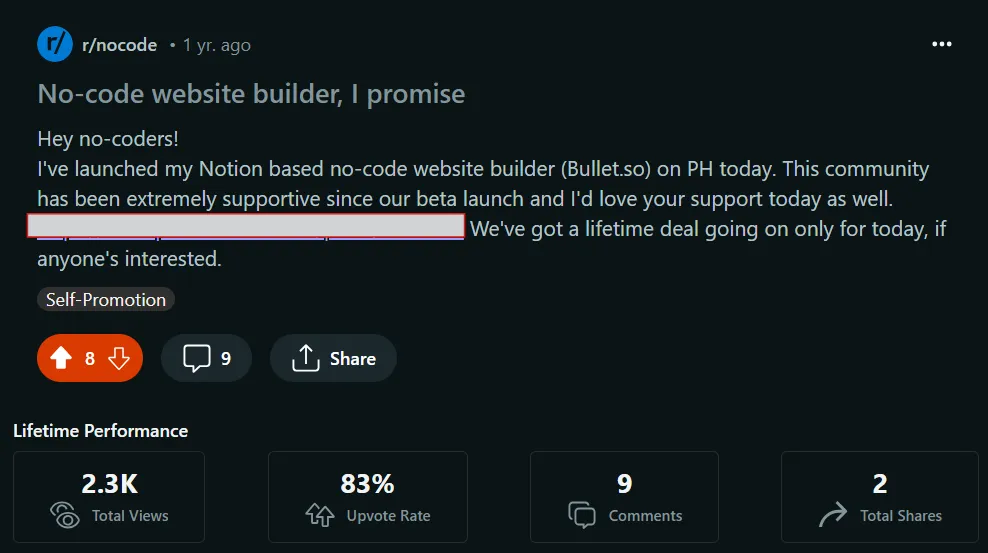
- No-Code subreddits like r/nocode, r/NoCodeFounders, and r/NoCodeDev.
- IndieHacker communities where No-Code founders were sharing tools.
These spaces were filled with users actively looking for tools like Bullet.so. And because they were already interested in No-Code solutions, their feedback was priceless. Many users in the No-Code communities left detailed comments on what they liked, what was missing, and what could be improved, helping us refine the product before launch.
3. Cracking Reddit’s Tough Algorithm (Without Getting Banned)
Reddit is notoriously strict about promotions. Drop a salesy link, and you’ll get downvoted to oblivion—or worse, banned.
So I took a different approach:
Step 1: Learn the Language of the Community
Every subreddit has its own vocabulary and culture. Before posting, I spent time:
- Reading top-performing posts to understand the tone.
- Commenting on existing threads to establish credibility.
- Engaging naturally without pushing Bullet.so.
Step 2: Create Thought Leadership Content
Instead of posting "Try my tool!", I wrote from a founder’s perspective:
- The problem we were solving.
- The struggle of launching a SaaS product with no budget.
- The excitement of turning Notion pages into websites.
This authentic storytelling made the posts feel natural rather than promotional.
Step 3: Soft CTA for Signups
Once people engaged with the posts, I casually mentioned,
"If anyone’s interested, we’re launching a beta—happy to share a link!"
Since it wasn’t forced, people asked for the link themselves.
Result? 100+ registrations just from Reddit and No-Code communities.
4. How This Translated to a Strong Launch
With a pre-built email list from our niche outreach, we had a ready audience on launch day. This helped us:
✅ Get instant beta testers who provided real feedback.
✅ Improve the product before the public launch.
✅ Convert early interest into $12,000 in sales within the first 30 days (which I’ll cover in the next blog).
Key Takeaways from Doing It All Myself
- Niche communities > Mass promotion – Targeting the right places worked better than broad outreach.
- Authenticity beats ads – Thought leadership posts generated more engagement than direct promotions.
- Pre-launch efforts = Post-launch success – The early email list turned into real sales.
- Expanding audience reach – Realizing Bullet.so’s No-Code potential helped us reach a second group of highly relevant users.
How I Used Organic Programmatic SEO to Generate 100,000 Website Visitors in Six Months
In 2021, I worked at Disbug, a bootstrapped Indian startup targeting American users. You can probably guess what that meant—we had zero marketing or advertising budget. The entire team was just the founder and me, which meant there was no marketing team to delegate tasks to. If something needed to be done, I had to figure it out and do it myself.
That’s when I discovered Programmatic SEO—a way to scale content and drive traffic without spending money on ads. What started as an experiment turned into a strategy that brought in 100,000 website visitors in six months.
Finding the Right Positioning
Initially, Disbug was positioned as a software testing tool, but I quickly realized that the market demand for that was low. Instead of trying to force our way into a niche with limited traffic, I looked for alternative positioning opportunities. I discovered three main angles:
- Screen Recording Tool – Targeting users searching for ways to record their screens on different operating systems.
- Integration Solutions – Positioning Disbug as a tool that integrates with platforms like Trello, ClickUp, and Slack.
- Chrome Extension for Developers – Highlighting the value of Disbug as a productivity tool for web developers.
Each of these angles had a significantly larger audience than "software testing tool," so I decided to go all in.
Building the Programmatic SEO Strategy
Since it was just me, I had to take care of everything—learning about programmatic SEO, researching keywords, creating content, publishing pages, and tracking performance.
1. Keyword Research & Content Planning
To scale efficiently, I focused on high-intent, long-tail keywords related to screen recording, integrations, and Chrome extensions. I categorized the content into:
- Screen Recording Topics:
- "9 Best Screen Capturing Tools for Chrome"
- "9 Best Screen Capturing Tools for Linux"
- "How to Record Your Screen on Your Mac"
- "9 Best Mac Screen Recorders"
- "How to Record Your Screen on Windows"
- "9 Best Screen Capturing Tools for Mac"
- Integration Topics:
- "Slack Integrations for Software Testing"
- "Jira Integration for Software Development"
- "Trello Power-Ups for Developers"
- "ClickUp Integration Tools"
- "Trello Power-Ups for Software Development"
- Chrome Extension Topics:
- "27 Best Chrome Extensions for Web Developers"
- "Chrome Extensions for Productivity"
These were just some of the topics I covered. The goal was to create a broad and deep content strategy that would position Disbug in multiple search results.
2. Content Creation & Automation
With 150 pages to publish, I needed a structured approach. I built a Webflow template with:
- Title & Meta Description – Optimized for search engines.
- Short & Long Descriptions – Providing clear, structured content.
- Logos & Images – To make the pages visually appealing.
For content, I used a mix of manual writing and AI tools (mainly Scalenut). One trick I used was Quora-style questions, which helped me generate simple, structured answers that I could fact-check and optimize.
Since there was no content team, I personally wrote, optimized, and published all 150 pages within a week.
The Results: 100,000 Visitors in 6 Months
Once the pages started ranking, the organic traffic grew fast. By the end of six months, Disbug had over 100,000 visitors, all from SEO alone. Every page strategically plugged Disbug as a recommended tool, ensuring the traffic wasn’t just numbers but potential users.
Key Takeaways from Doing Everything Myself
Working alone meant I had to be hands-on with every part of the strategy. This experience taught me:
- Positioning is everything – Finding the right angle can make or break an SEO strategy.
- SEO at scale works – When done right, programmatic SEO can drive massive traffic without ads.
- Speed is an advantage – Publishing 150 pages in a week helped me get ahead of competitors.
Since this project, I’ve refined my strategies even further, applying what I learned to bigger and better projects. But this was my first real dive into Programmatic SEO, and it proved that creative, scalable content strategies can drive real growth—even when you’re doing everything alone.